
Creatine and the Brain — What Does Science Really Say About Cognitive Benefits?
- Nima Sadraiefar
- 1 day ago
- 2 min read

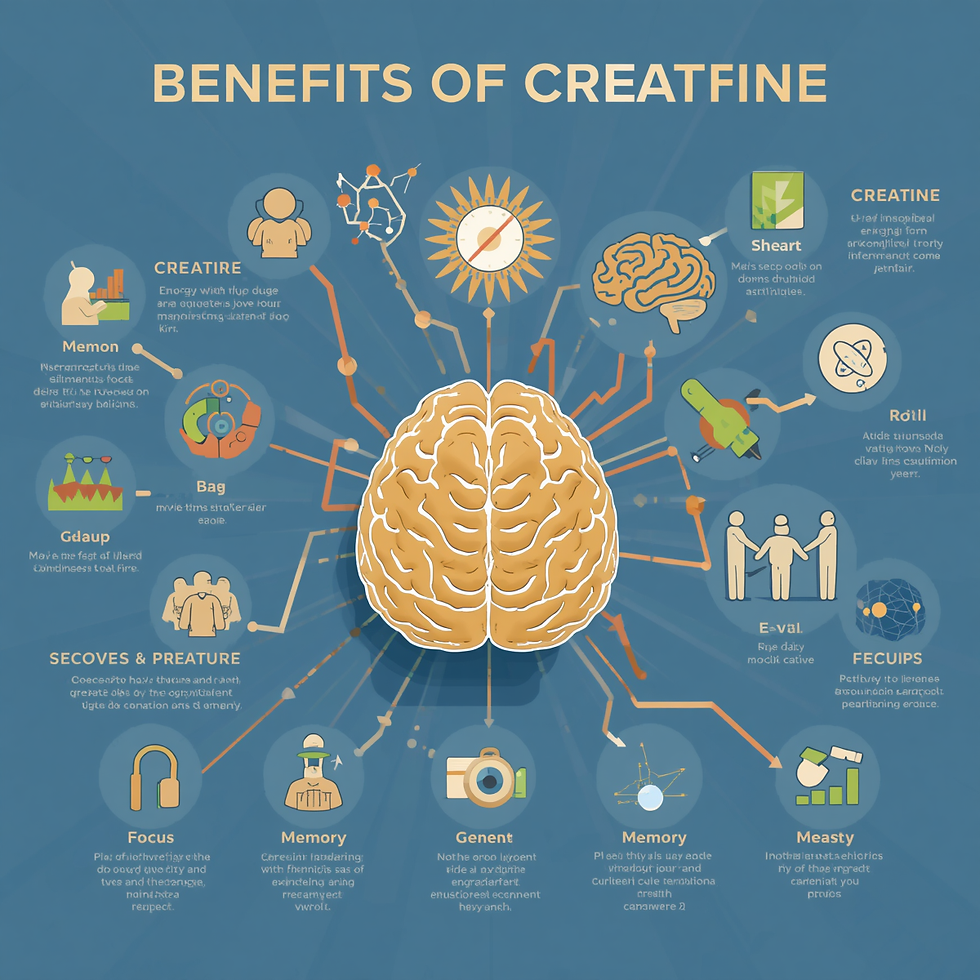
Creatine is among the most extensively studied dietary supplements globally, primarily associated with muscle and strength. Recently, however, researchers have begun exploring an intriguing question: can creatine enhance cognitive function? The brief answer is yes, potentially—but with significant caveats.
Creatine’s Role in Brain Energy Metabolism
Creatine is crucial in cellular energy production by aiding the rapid regeneration of adenosine triphosphate (ATP), the brain’s main energy currency. While approximately 95% of creatine is stored in skeletal muscle, the brain is one of the body’s most energy-demanding organs, consuming about 20% of total daily energy despite its small size. [pmc.ncbi.nlm.nih.gov]
Neurons heavily depend on ATP for signal transmission, synaptic plasticity, and maintaining membrane potentials. When energy availability is compromised—such as during sleep deprivation, aging, or neurological disorders—cognitive performance can decline. Creatine supplementation has been shown to increase brain creatine stores, potentially enhancing energetic buffering in these situations. [pmc.ncbi.nlm.nih.gov], [mdpi.com]
Evidence From Randomized Controlled Trials
An increasing number of randomized controlled trials (RCTs) have investigated whether boosting creatine availability leads to noticeable cognitive improvements. The most thorough evaluation to date is a 2024 systematic review and meta-analysis that examined 16 RCTs involving nearly 500 participants. [pmc.ncbi.nlm.nih.gov]
The results were nuanced yet encouraging:
Significant improvements in short-term memory
Faster attention and information processing speed
No consistent improvement in executive function or global cognition
Notably, the authors rated the certainty of evidence for memory improvement as moderate, indicating that the observed benefits are both genuine and reproducible, albeit modest in size. [pmc.ncbi.nlm.nih.gov]
Who Benefits the Most?
Creatine’s cognitive effects seem to be context-dependent. The most significant improvements are seen in individuals with:
Lower baseline brain creatine, such as vegetarians or vegans
Acute cognitive stress, including sleep deprivation or intense mental workload
Clinical conditions, such as depression, mild traumatic brain injury, or age-related cognitive decline
Previous systematic reviews also noted that vegetarians consistently experienced greater memory benefits compared to omnivores, likely due to lower habitual dietary creatine intake. [gwern.net]
What About Healthy Adults?
In healthy, well-rested adults, the effects are subtle but detectable. The largest double-blind trial to date (published in BMC Medicine) found small cognitive improvements, particularly in working memory, though some outcomes narrowly missed conventional statistical significance. [link.springer.com]
While these effects might seem modest, cognitive researchers highlight that small improvements at the population level can lead to significant real-world benefits, given creatine’s low cost and excellent safety profile. [link.springer.com]
Safety and Practical Considerations
Creatine monohydrate remains one of the safest dietary supplements studied. Across cognitive and performance trials, adverse effects are minimal and typically limited to mild gastrointestinal discomfort in some individuals. [pmc.ncbi.nlm.nih.gov], [link.springer.com]
Typical dosing protocols for cognitive research range from 3–5 g per day, without the need for loading phases.
Bottom Line
Creatine is not a miracle nootropic, but evidence strongly supports its role as a brain energy support compound, especially under conditions of metabolic stress or low baseline creatine availability. For cognitive health, creatine represents a rare combination of biological plausibility, clinical evidence, affordability, and safety—a combination that few supplements can claim.


Comments